Tech layoffs: what to expect in 2026
Tech layoffs are continuing into 2026 at over half of 2025's full-year pace, driven by AI-led restructuring rather than pandemic-era cost correction — here's what CHROs and people leaders need to plan for. If you're leading workforce planning or people analytics, the layoff data is not just news; it's a signal shaping your internal mobility strategy, your reskilling roadmap, and the skill baselines you need to establish across your organization.
The scale over the past four years: roughly 97,000+ job cuts in 2022 and 191,000-260,000 in 2023, per Challenger, Gray & Christmas (Challenger, Gray & Christmas full-year 2022 tech sector figure). In 2024, Challenger reported ~134,000 tech-sector cuts (Crunchbase's U.S.-only tally was ~95,000). In 2025, cuts topped 154,000 per Challenger. Through April 2026, Challenger has already logged 85,411 tech-sector cuts — more than half of 2025's full-year total — with Meta executing an additional ~8,000 cuts announced in April 2026.
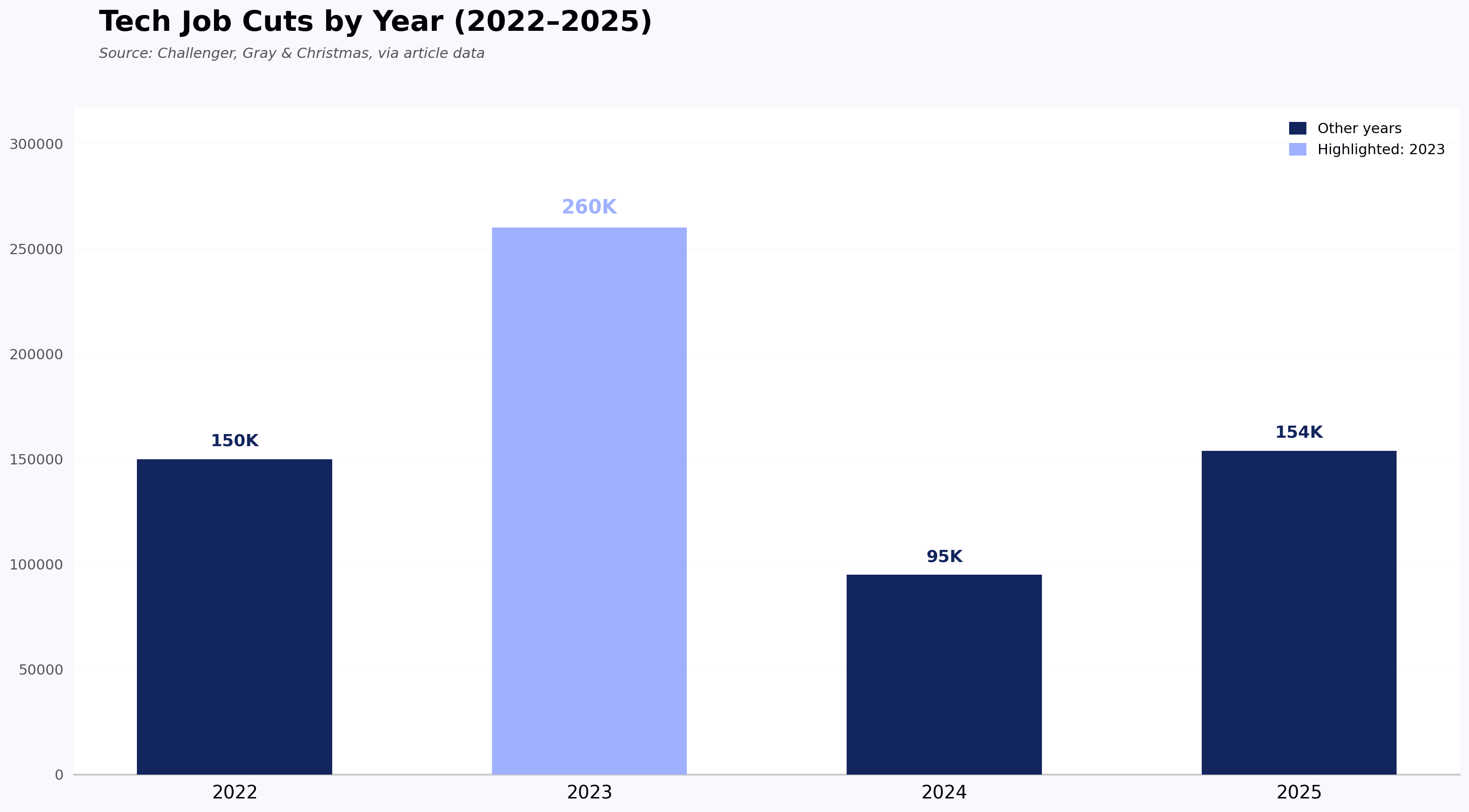
Quick answer: are tech layoffs still happening in 2026?
Yes — and the reason has shifted. Where 2022–2023 cuts were largely corrections to pandemic-era over-hiring, 2025 marked the year AI-led restructuring became the named driver, and 2026 is extending that pattern. For people leaders, that means fewer mass "cost-cutting" waves and more targeted, role-specific reductions — especially in middle management, QA, support, and individual-contributor software engineering roles that AI coding tools can now augment. It also means the internal talent picture — who to reskill, who to redeploy, where capability gaps sit — looks very different than it did 18 months ago.
How bad have tech layoffs been recently?
Different trackers report different figures because each uses a different methodology — some count only U.S.-based companies, others count global cuts, and some only include public announcements. Here's how the leading sources compare for 2025 (all figures reflect year-to-date data as of Q4 2025):
- 154,000+ tech job cuts in 2025 — Challenger, Gray & Christmas monthly job cut reports, U.S.-focused, based on publicly reported reductions.
- ~127,000 workers laid off at U.S.-based tech companies — Crunchbase News tally of public announcements from U.S. tech employers.
- 244,000+ global tech-sector layoffs — Computerworld's running timeline, aggregating worldwide reductions.
- Layoffs.fyi logged cuts at 280+ tech companies through 2025 (point-in-time snapshot as of Q4 2025; the tracker is live and current figures may be higher — readers should check the source directly for the latest count).
- TrueUp reported 783 layoff events affecting 245,953 people across tech in 2025 (as of Q4 2025 per TrueUp's methodology). For context, that pace works out to roughly 674 people impacted per day across the sector — a useful frame for understanding the scale of displaced talent moving through the market.
The gap between the U.S. figure (~127,000) and the global figure (244,000+) largely reflects scope. The difference between Challenger's 154,000 and Crunchbase's 127,000 reflects methodology: Challenger includes any tech-adjacent employer, while Crunchbase focuses on venture-backed and public tech companies. TrueUp's higher count (245,953) reflects its global scope and inclusion of all reported layoff events across the tech sector, whereas Challenger's 154,000+ tracks U.S. publicly announced tech-sector reductions.
Major contributors across the year: Microsoft (multiple rounds), Meta, Amazon, Intel, Salesforce, Google, and Cisco. The dominant themes: AI-driven restructuring, elevated interest rates, cautious enterprise IT spending, and continued correction from 2021–2022 over-hiring.
Are more tech layoffs coming in 2026?
Analysts expect the pattern to continue, with cuts increasingly targeted at specific roles rather than broad workforce reductions. Early 2026 data confirms the trend: tech companies had logged 85,411 cuts through April 2026 per Challenger — more than half of 2025's full-year total; more recent Challenger data through April 2026 shows the sector-cut total continuing to climb. Editorially, it's worth flagging a counter-view: some commentators and workers argue the AI-driver framing overstates automation's current impact and provides convenient cover for cost-cutting and financial-engineering motives. We aren't taking a side here, but it's a debate people leaders should factor into how they communicate cuts internally.
1. AI is now the named driver
In 2025, AI moved from experimental to embedded in most large tech companies, and Challenger, Gray & Christmas reports showed AI-attributed cuts accelerate sharply — Challenger has tracked AI as a named reason since 2023, but 2025 saw 54,836 AI-attributed cuts, the largest annual total on record. For people leaders, the roles most exposed include:
- Customer support and success
- Content moderation and QA testing
- Junior software engineering and code review
- HR operations and recruiting coordination
- Marketing operations, copywriting, and design production
- Middle management layers (as AI tools flatten reporting structures)
A widely cited Goldman Sachs analysis from March 2023 projected that generative AI could expose the equivalent of 300 million full-time jobs globally to some degree of automation. (Note: this is a 2023 projection; readers tracking newer estimates should consult more recent labor-market research.) This suggests tech will be among the earliest sectors to see net displacement — which is why the workforce-level skill baselines you establish today should differ from those you relied on two years ago.
2. Hiring won't stop — it will shift
Even as companies reduce headcount in one function, they are hiring in another, though these growth markets are competitive and selectively contracting at some companies too. Workforce planning is now rebuilding capacity around:
- Machine learning and AI engineers
- Data infrastructure and platform engineers
- AI safety, governance, and compliance roles
- Cybersecurity specialists
- Cloud and GPU infrastructure engineers
Skills-based signals matter more here than degree- or resume-based signals — many strong internal candidates can transition laterally from adjacent engineering roles, and degree- and resume-based filters miss them.
3. Big Tech will keep trimming middle management
Amazon, Meta, Google, and Microsoft all publicly stated in 2024–2025 that they want "flatter" organizations. This is likely to intensify in 2026, with a specific focus on layers of managers-of-managers.
4. Startups will face a different squeeze
Analysts expect late-stage startups burning through 2021-era capital without a clear AI story to struggle to raise. Signals from late 2025 suggest a wave of consolidation, acqui-hires, and shutdowns in H1 2026.
5. Geographic rebalancing is likely to continue
Companies are shifting engineering headcount away from high-cost U.S. hubs (San Francisco, Seattle, New York) toward India, Eastern Europe, and Latin America. This has surfaced sharply in California, where a large share of 2025's U.S. tech cuts were concentrated — Meta, Google, Salesforce, and Intel all reported California-heavy reductions in their WARN filings. Analysts expect the rebalancing to continue through 2026.
What causes tech layoffs?
The core drivers heading through 2026:
- AI automation: Tools like GitHub Copilot, Claude, and internal LLMs are reducing the number of humans needed per project.
- Interest rates and capital costs: Even with rate cuts, capital is more expensive than it was in 2021.
- Over-hiring correction: Some companies are still normalizing headcount after 2020–2022 growth. HackerEarth's analysis of the pandemic-era hiring build-up covers how this correction has played out.
- Restructuring and M&A: Consolidation creates overlap and redundancy.
- Shifts in demand: Enterprise buyers are cutting SaaS spend and consolidating vendors.
- Government and contract changes: Companies dependent on federal IT contracts face volatility.
Which company types are most at risk in 2026?
| Company type | Layoff risk in 2026 |
|---|---|
| Late-stage SaaS startups without AI moat | Elevated |
| Traditional enterprise software vendors | Elevated |
| Big Tech (Meta, Amazon, Google, Microsoft) | Ongoing but targeted |
| AI infrastructure and foundation model labs | Net hiring |
| Cybersecurity firms | Stable |
| Semiconductor manufacturers | Cyclical |
| Consumer hardware companies | Mixed |
| Fintech and crypto | Mixed |
Risk tiers are HackerEarth's editorial synthesis of 2025 layoff patterns and public analyst commentary from Challenger, Crunchbase, and TrueUp — not a quantitative model.
How to track tech layoffs in 2026
For people teams monitoring competitor cuts, external labor-market movement, and market signals:
- Layoffs.fyi — the most-cited independent tracker since 2020.
- TrueUp Layoffs Tracker — daily updated, with company and role breakdowns.
- Crunchbase News Layoffs Tracker — focused on U.S. companies.
- Challenger, Gray & Christmas monthly reports — the source most media outlets cite.
- Bureau of Labor Statistics (BLS) — official U.S. government data on layoffs and unemployment.
- LinkedIn and X (Twitter) — the fastest way to see layoff lists and identify displaced talent. For a snapshot of how developers themselves have interpreted the layoff wave, HackerEarth documented what developers think of layoffs in tech.
How can companies reduce the need for layoffs?
Before cutting headcount, leadership teams have several alternatives worth considering:
- Hiring freeze — pause new roles instead of eliminating existing ones. HackerEarth has covered what recruiters can focus on during a tech hiring freeze in more detail, including how to use freeze periods to strengthen internal talent supply.
- Reskilling into AI-adjacent roles — retrain existing engineers on ML tooling, prompt engineering, and AI ops. Establishing a workforce-level skill baseline before reskilling investment is what makes ROI defensible to the board.
- Voluntary separation packages — offer exit packages before forced cuts.
- Reduced hours or four-day workweeks — trim payroll without losing talent.
- Non-essential expense cuts — travel, real estate, vendor consolidation, and perks first. Cost-side levers are covered in more depth in HackerEarth's strategic guide to reducing hiring costs in 2026.
- Salary freezes over reductions — preserve morale where possible.
What jobs are likely to shrink in tech over the next 5 to 10 years?
Based on current AI trajectories, these roles are most at risk of shrinking meaningfully over the next 5 to 10 years (through 2030-2035):
- Manual QA testers
- Tier-1 technical support
- Data entry and data annotation
- Routine content production (copywriting, basic design)
- Recruiting coordinators and schedulers
- Junior bookkeepers and finance ops
- Basic legal research and paralegal work
- Large portions of junior software development
Roles that are expected to grow: AI engineers, ML researchers, data platform engineers, cybersecurity, AI ethicists and governance leads, and skilled trades that support data-center buildout (electricians, HVAC, technicians).
Are candidates buying the "recovery" narrative?
The short answer, per public sentiment on Reddit's r/careerguidance and r/cscareerquestions through late 2025, is no. Threads with titles like "154k tech layoffs in 2025, up 15% from 2024 — anyone else tired of 'the market is recovering' takes?" capture a persistent skepticism that recovery framing does not match the lived experience of displaced workers. These are anecdotal signals, not survey data — but they align with what many talent teams report in outbound response rates and offer conversations. Editorially, we'd note that messaging which engages honestly with layoff data — rather than defaulting to recovery framing — is more likely to hold up in candidate conversations than optimistic talking points that contradict what displaced workers are seeing.
FAQ: tech layoffs
Is there a layoff tracker for 2025 and 2026? Yes — see the trackers listed in the "How to track tech layoffs in 2026" section above. For people teams, the practical difference between them is scope: Layoffs.fyi and TrueUp aggregate global company-level events with role breakdowns useful for identifying displaced talent, while Challenger and BLS give macro-level trend data better suited to board reporting.
How many jobs were cut due to AI in 2025? Challenger, Gray & Christmas reported that a significant portion of 2025's 154,000+ tech job cuts were attributed to AI adoption and automation — Challenger has tracked AI as a named driver since 2023, and 2025's ~54,836 AI-attributed cuts represent the largest annual total since tracking began. Challenger's public monthly reports do not always break out a specific AI-attributed count separate from other drivers, so the precise figure for AI-driven cuts is not consistently disclosed; readers should consult Challenger's most recent monthly release for the current attribution.
Will there be more tech layoffs in 2026 than in 2025? Early data suggests continued elevated activity. Through April 2026, Challenger reported 85,411 tech-sector cuts — over half of 2025's total — with Meta executing an additional ~8,000 cuts announced in April 2026. Whether the full-year 2026 number exceeds 2025 depends on Q2–Q4 activity, but the pace in early 2026 is running ahead of 2025's equivalent period.
Which companies laid off the most tech workers in 2025? Microsoft, Meta, Amazon, Intel, Google, and Salesforce were among the largest contributors, each announcing multi-thousand-person reductions across the year.
Who is most at risk of tech layoffs in 2026? Individual contributors and managers in middle-management layers, manual QA, Tier-1 support, recruiting coordination, marketing operations, and junior software engineering face the highest personal risk in 2026. Seniority-wise, managers-of-managers are specifically exposed as Big Tech flattens org charts. Geographically, workers in high-cost U.S. hubs (San Francisco, Seattle, New York) face elevated risk as companies rebalance headcount toward India, Eastern Europe, and Latin America.
What jobs will be obsolete in the next 5 to 10 years? The roles most at risk of significant shrinkage by 2030-2035 include manual QA testing, Tier-1 technical support, data entry and annotation, routine content production, recruiting coordination, junior bookkeeping, basic paralegal work, and large portions of junior software development. Growth roles include AI/ML engineering, data platform work, cybersecurity, AI governance, and data-center trades.
What jobs will be gone by 2030 due to AI? By 2030, AI-driven automation is expected to significantly shrink roles including manual QA testing, Tier-1 technical support, data entry and annotation, routine content production (copywriting and basic design), recruiting coordination, junior bookkeeping, basic paralegal work, and large portions of junior software development. These are not projected to disappear entirely, but headcount in these categories is expected to contract meaningfully as AI tools absorb routine tasks.
Will hiring recover in 2026? Based on current analyst commentary from Challenger, Crunchbase, and TrueUp, recovery to 2021 hiring volumes is not expected. Unlike the body outlook, the specific composition matters: net-new hiring is concentrating in AI infrastructure, foundation-model teams, and AI safety and governance functions — areas that did not exist as headcount categories in 2021. For CHROs, that means "recovery" is better understood as a skills-mix change than a volume return.
Next steps: build a workforce plan that reflects the new mix
Tech layoffs in 2025 and early 2026 are quieter, more targeted, and more permanent than the shock-wave cuts of 2022 — because many of the roles being cut are being replaced by software, not paused. For CHROs and people analytics leaders, workforce planning now has to account for displaced senior engineers, career-switchers moving into AI-adjacent roles, and mid-career managers whose layers have been flattened. Headcount-only reporting misses the capability transitions that matter.
If you're rebuilding your skills taxonomy around AI, ML, data engineering, and security, HackerEarth Assessments can map workforce-level skill gaps against the roles you need in 2026, so L&D spend targets the specific capabilities your 2026 roadmap requires.