Why a Skills-Based Approach Matters in Hiring
AI hiring software is most useful when it evaluates candidates on demonstrated skills — yet most hiring still leans on resumes, job titles, and gut-feel conversations, despite structured work samples consistently outperforming unstructured interviews (Schmidt & Oh, 2016).
These resume signals are convenient. They rarely capture real capability or accurately predict future job performance.
AI hiring software is a category of recruitment technology that evaluates candidates on demonstrated skills — through work samples, coding tasks, or role-specific simulations — and uses machine learning to score, rank, and compare them consistently. Choosing the right platform means judging it on assessment quality, scoring transparency, and integration fit, not just automation speed.
From process efficiency to talent intelligence in AI recruitment
AI hiring software is often positioned as an efficiency driver, reducing time to hire and automating repetitive hiring tasks. Those benefits are real, but they are only the surface — the larger gain is in the quality of hiring decisions themselves.
Modern AI hiring software enables organisations to:
- Analyse candidate performance through skill-based assessments at scale
- Identify patterns that correlate with high performance in specific job roles
- Continuously refine hiring models using real outcome and performance data
- Reduce subjectivity by anchoring hiring decisions in structured evaluation frameworks
Work sample tests have historically shown strong predictive validity for job performance — with early estimates around 0.54 (Hunter & Hunter, 1984, as cited in Schmidt & Oh, 2016), though more recent meta-analyses place the figure at approximately 0.33 (Roth, Bobko & McFarland, 2005, as cited in Schmidt & Oh, 2016). Either way, structured work samples consistently outperform unstructured interviews. Note: the Schmidt & Oh (2016) paper is a widely cited working paper rather than a formally peer-reviewed journal article.
Hiring accuracy improves when decisions are based on demonstrated skills and real capability, not assumptions.
Reframing candidate evaluation: what to prioritize when choosing AI hiring software
1. High-fidelity skill assessment
At the core of skills-based hiring is the ability to evaluate candidates in environments that reflect real job conditions.
This means moving beyond theoretical assessments toward the following:
- Real-world coding challenges
- Project-based candidate evaluations
- Role-specific job simulations
These approaches shift hiring from assumption-driven screening to evidence-based talent validation.
Instead of asking, "Can this candidate do the job?"
You observe, "How well do they actually perform in real scenarios?"
2. Structured and defensible hiring decisions
Inconsistency is one of the biggest risks in traditional recruitment.
Different interviewers. Different evaluation criteria. Different interpretations.
AI-driven hiring systems address this by introducing the following:
- Standardised candidate scoring frameworks
- Consistent benchmarking across applicants
- Comparable, data-driven insights across all hiring stages
This does not just improve hiring efficiency. It creates auditability and compliance.
Under employment discrimination scrutiny and internal review, hiring decisions need to be not just effective, but also transparent and defensible.
3. Bias reduction through AI system design
Bias in hiring remains a critical concern, especially when AI systems rely on historical hiring data.
To address this, HR leaders must prioritise AI hiring software that:
- Focuses on candidate skills and performance, not pedigree
- Provides transparency in evaluation criteria and scoring
- Allows for human oversight and intervention in hiring decisions
Structured evaluation frameworks tend to reduce interviewer-to-interviewer variance, which is one of the main channels through which bias enters hiring decisions. AI hiring tools can also make bias worse — for example, when training data is drawn from a narrow historical hiring pool, when job taxonomies are poorly defined, or when simulations penalise candidates from non-traditional backgrounds for surface-level differences rather than capability gaps. For a deeper look at where AI systems can help and where they can introduce new risks, see our guide to mitigating AI bias in recruitment.
When implemented correctly, AI-driven scoring is more consistent across candidates than human-led screens, applying the same rubric regardless of interviewer mood or fatigue. The goal is not to remove humans from hiring but to augment human judgment with consistent, data-backed insights.
4. Candidate experience as a strategic hiring KPI
In the push for recruitment efficiency, candidate experience is often overlooked — and that costs offers, referrals, and brand equity.
Candidate experience directly impacts:
- Employer branding and reputation
- Offer acceptance rates
- How candidates describe your hiring process to peers
Treat candidate experience as a core hiring metric, not a side effect.
Effective AI hiring software:
- Delivers relevant and engaging skill assessments
- Provides timely communication and feedback
- Reflects the actual nature of the job role
Even candidates who are not selected should leave with a strong sense of fairness and transparency.
Rejected candidates who felt the process was fair are more likely to reapply and refer peers.
5. Integration as a value multiplier in HR tech
AI hiring software does not create value in isolation.
Their true impact comes from integration with existing HR technology systems such as ATS platforms and HRIS software.
This enables:
- End-to-end recruitment data continuity
- Reduced manual hiring effort
- Unified visibility across hiring teams
For HR leaders, integration is not just a technical feature. It is what lets a hiring process scale across concurrent requisitions and multiple hiring teams without losing consistency of evaluation.
Without proper integration, even the most capable recruitment tools risk becoming siloed systems.
A short checklist for evaluating AI hiring software
Use these at the vendor shortlisting stage, before committing to a proof of concept.
Use these questions when comparing vendors:
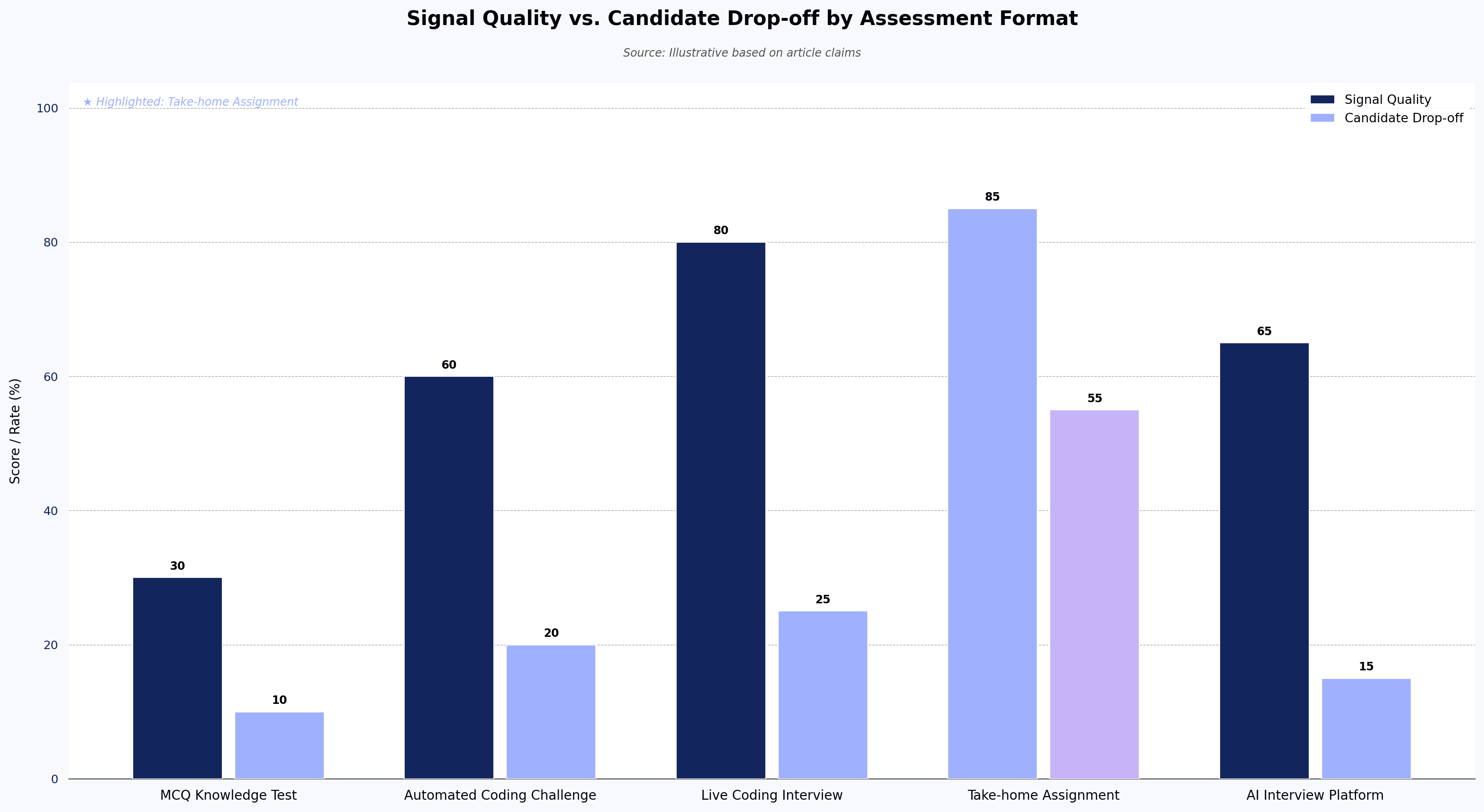
- Does the platform assess role-relevant skills through work samples or simulations, not just multiple-choice questions?
- Can you see and audit the scoring criteria for every candidate?
- Does it offer native integrations with your ATS and HRIS, or only file exports?
- What controls exist to detect and mitigate bias in scoring models?
- Does the vendor publish validation data on how their assessments correlate with on-the-job performance?
Operationalising skills-based hiring
Most of the value in a skills-based approach shows up only when assessments reflect the actual work — a shipping coding task, a debugging exercise, a design review — rather than a generic aptitude quiz. HackerEarth's role-specific coding assessments are built around that idea: candidates are evaluated on role-specific coding work using rubric-based scoring against a structured evaluation framework. The point is not the tooling; it is that hiring decisions become grounded in observed performance instead of inferred potential.
In technical hiring especially, problem-solving ability, adaptability, and execution on realistic tasks matter far more than credentials or degrees. For a closer look at how AI is reshaping technical evaluation, see the role of AI in hiring software engineers.
Managing the transition to AI hiring software
The case for AI-driven, skills-based hiring is strong, but implementation comes with challenges.
Common barriers include:
- Resistance from hiring managers accustomed to traditional hiring signals
- Limited familiarity with AI-powered recruitment tools.
- Concerns around AI transparency and explainability
By AI-powered recruitment tools, we mean tools that use models trained on prior candidate performance data — submissions, scores, and rubric ratings from earlier assessments — to score new responses against structured rubrics. Their main limitation is that they inherit whatever bias sits in that historical data, which is why human reviewers still make the final call.
To successfully transition, organisations need to focus on:
- Clearly communicating business impact and hiring ROI
- Training and enabling hiring teams on AI tools
- Rolling out changes in phased and manageable steps
AI should be positioned as a scoring and pattern-detection layer that supports human decisions, not a replacement for human decision-making. For a broader view of common obstacles and how teams work through them, see our overview of recruitment challenges and solutions.
The future of hiring: skills over credentials
Degrees and job titles are becoming less reliable indicators of candidate success.
Skills offer a more dynamic, measurable, and context-specific view of talent than credentials do. A skills assessment test surfaces demonstrated capability that resumes rarely reveal.
According to the World Economic Forum Future of Jobs Report 2025, surveyed employers expect 39% of workers' core skills to change by 2030 — down from 44% expected in the 2023 report, suggesting the pace of change is stabilising rather than accelerating.
For hiring teams, that means the skills you screen for today will not match the skills the role requires in three years — a strong argument for assessing learning ability and current demonstrated skill rather than fixed credentials.
FAQ
What is AI hiring software?
The term covers a wide range — from resume parsers and chatbots at one end to structured skills assessment platforms at the other. In this article, AI hiring software refers specifically to the assessment-and-scoring end of that spectrum: platforms that use work samples or simulations to evaluate demonstrated skills, apply machine learning to score responses against structured rubrics, and integrate results into ATS and HRIS systems. Resume-screening AI is a different category with different validity concerns.
How does skills-based hiring differ from traditional resume screening?
Traditional screening infers ability from proxies like degrees and past titles; skills-based hiring measures ability directly through work samples. The common failure mode in rollouts is designing assessments that are technically 'skills-based' but generic — a standard aptitude quiz used across every role — which reintroduces the same proxy problem in a new form. Resume screening still has a place as a lightweight filter for hard eligibility criteria (right to work, required certifications), but not as the primary judgement of capability.
Why should AI be used in hiring?
The honest answer is that AI in hiring is only worth using where it beats a well-designed structured process — and it often does not. Its clearest value is in scoring standardised work samples at volume, where consistency across thousands of submissions is impossible for a human panel. Its weakest use is autonomous resume screening, where models tend to encode the biases of past hiring decisions. If a team cannot articulate which of the two ends they are buying, they should not buy yet.
What should HR leaders look for when choosing AI hiring software?
The single most useful filter is whether the vendor will show you validation data — how their assessment scores correlate with on-the-job performance for roles like yours. Most will not, or will only share aggregate marketing figures. A vendor that can produce role-level validation, or is willing to run a validation study against your existing hires, is signalling something meaningfully different from one that only markets accuracy.
Conclusion: from hiring processes to talent intelligence systems
Choosing AI hiring software is no longer a tactical HR decision — it is a strategic business decision.
The organisations that get this right will do more than swap a screening tool. They will replace proxy-based judgement with recorded evidence of what candidates can do, apply the same structure and scoring criteria to every applicant, and use accumulated performance data to keep refining what a strong hire actually looks like for each role.
Because hiring is not just about filling open roles. It is about consistently identifying capable candidates — including those without traditional credentials — who would be missed by resume-based screening.
See skills-based hiring in action
Explore how HackerEarth Assessments helps engineering teams evaluate candidates on real coding work — schedule a demo of HackerEarth Assessments to see it against your current hiring workflow.