How does HackerEarth combat the use of ChatGPT and other LLMs in tech hiring assessments?
Yes, ChatGPT can pass many unproctored technical coding assessments — particularly those built around well-defined problems and standard algorithms, where it produces working code within seconds. As of 2025, in our experience working with HackerEarth customers, hiring teams routinely report encountering this behavior in take-home tests — treat this as a practitioner observation rather than a surveyed statistic. That single behavior change has put pressure on the assumption most technical hiring pipelines were built on: that a take-home assessment measures what a candidate can do alone. The role of ChatGPT in hiring assessments is now the central design question for anyone running technical screens at scale.
This guide is written for technical recruiters and hiring managers who need to keep assessment signal high without alienating candidates or running afoul of compliance requirements. It covers what ChatGPT can and can't do in a hiring context, how recruiters are responding, and the specific HackerEarth controls that address AI-assisted cheating. For related reading on structuring evaluations, see our guides on conducting effective technical interviews and recruitment automation best practices.
What ChatGPT and LLMs actually are
A Large Language Model (LLM) is a machine-learning model trained on massive text corpora to generate human-like language and code. LLMs power translation tools, chatbots, content generators, and coding assistants.
ChatGPT is OpenAI's conversational LLM, launched publicly in November 2022. It can hold contextual dialogue, generate working code, explain concepts, and complete a wide range of natural-language tasks. Other conversational LLMs in the same category behave similarly on assessment tasks. Anthropic's Claude is another conversational LLM accessible through its own chat interface. Google's Gemini is another conversational LLM that candidates may be able to reach through Google's products. GitHub Copilot, embedded directly in IDEs, is a distinct threat vector because it does not require a tab switch to invoke. All four are increasingly accessible to candidates, so an assessment strategy has to assume any of them may be available. For developers, ChatGPT functions as a fast, capable coding assistant, which is precisely why it has become a challenge for hiring teams running unproctored technical assessments.
How candidates use ChatGPT in coding tests and hiring assessments
In our experience working with hiring teams across HackerEarth Assessments, here is how ChatGPT typically performs on technical assessment content. LLMs evolve quickly, so today's limitation may not hold six months from now.
- Theoretical and definitional questions. ChatGPT typically returns accurate answers on anything that sits in its training data — syntax, standard algorithms, framework basics.
- Working code for well-defined problems. ChatGPT can produce clean solutions to common coding challenges and easy-to-medium difficulty problems when given clear parameters.
- Contextual and logical reasoning. ChatGPT often interprets prompts literally, which can trip it up on scenario-based questions.
- Multi-component problems. ChatGPT can produce individual modules but often struggles to stitch them into a working system that spans an entire application.
- Unusual context or business logic. ChatGPT tends to produce less accurate output on anything that requires synthesizing multiple constraints or understanding a specific scenario.
Each model release closes some of these gaps, so assessment design has to keep pace.
ChatGPT in hiring assessments: plagiarism or progress?
Both — the right treatment depends on the role, and hiring teams are landing in two camps.
Camp 1: treat AI use as disqualifying
This approach fits high-volume hiring — campus drives, early-career pipelines, and mass screening where you're filtering hundreds or thousands of candidates. The goal is a clean signal on unassisted problem-solving ability, and any use of ChatGPT in hiring assessments is treated as a form of plagiarism.
Limitation: aggressive proctoring (screen recording, webcam monitoring, keystroke logging) can create friction with candidates who require accommodations under laws such as the Americans with Disabilities Act, and it may run into regional data-privacy constraints — for example, GDPR Article 9 restricts processing of biometric data used for unique identification, which in some regulatory interpretations includes keystroke and behavioral patterns when used for identification. Specifically, teams using HackerEarth should review which proctoring features they enable (webcam capture, keystroke logging, environment scans) against their jurisdiction's requirements; most of these controls can be toggled independently in the assessment configuration. Data-privacy questions are outside the scope of this article — consult legal counsel for your jurisdiction before finalizing a proctoring policy.
Camp 2: allow AI use, evaluate the human layer
This works better for senior or specialist roles — typically L5, Staff, or Principal engineers — where AI tooling is already part of the day-to-day workflow. If a staff engineer uses Copilot and ChatGPT in their real job, testing them without those tools may not reflect actual on-the-job performance. Here, the evaluation shifts to how well the candidate directs the AI, validates its output, and integrates it into a working solution.
Limitation: allowing AI use can disadvantage candidates without paid access to premium models, introducing an equity issue. It also makes cross-candidate comparability harder, since two candidates may lean on very different tools to produce similar output.
Neither approach is correct in the abstract — the right choice depends on the role, seniority, and the specific competencies being tested. HackerEarth Assessments supports both. Teams that want strict, AI-free evaluation can use the proctoring stack. Teams that want to allow AI can design assessments that measure AI-augmented skill.
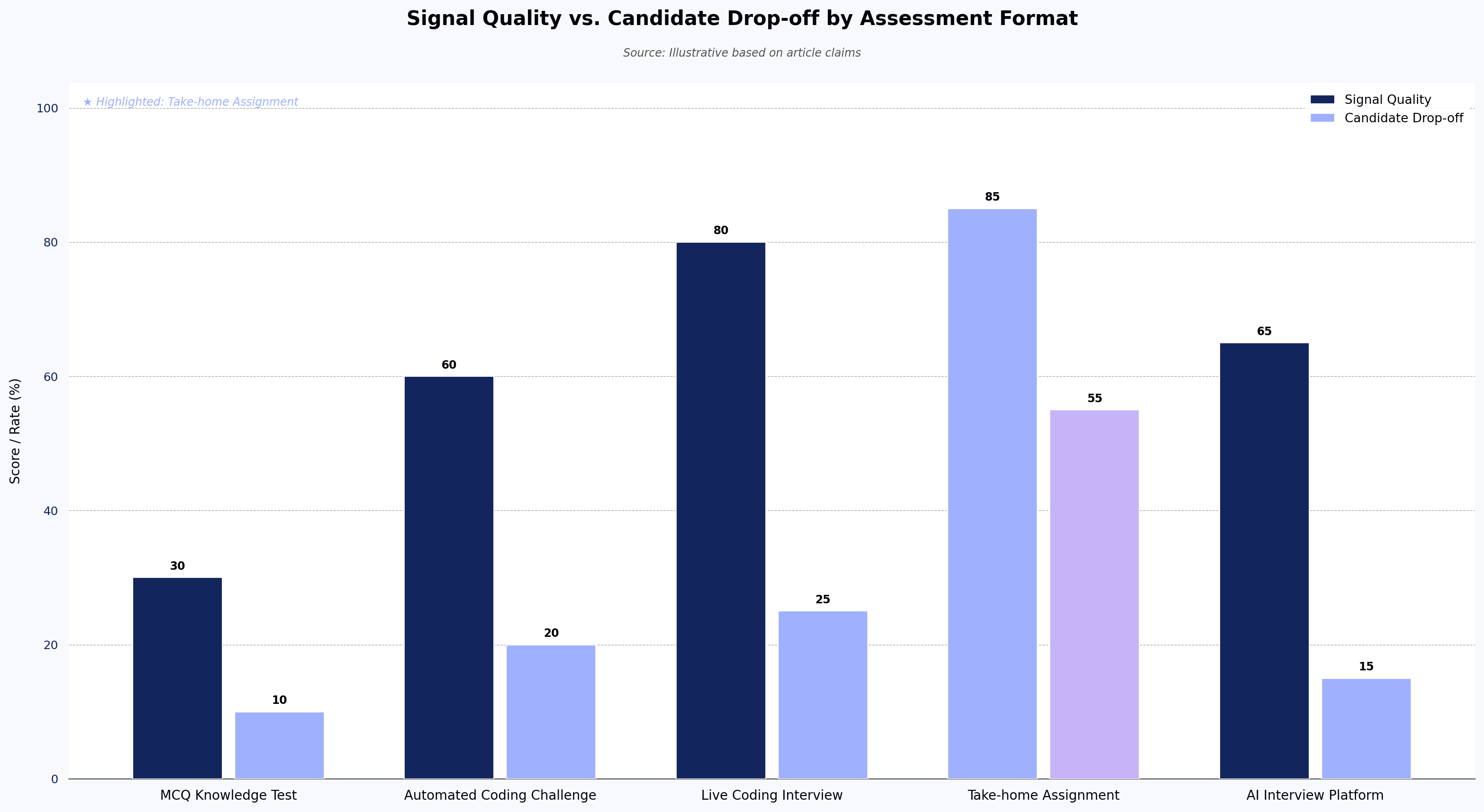
Take-home tests without proctoring are increasingly difficult to defend as a primary screen for roles below senior level, and many hiring teams are reconsidering the format.
How HackerEarth detects and prevents ChatGPT use in hiring assessments
HackerEarth Assessments combines browser lockdown, tab-switch detection, full-screen enforcement, and LLM-resistant question design to prevent AI-assisted cheating during technical screens.
1. Smart Browser
Smart Browser is HackerEarth's most rigorous proctoring layer, delivered through a desktop application. It is available on select plans — check with your account team on whether it is included in your current tier. When enabled, it locks down the candidate's testing environment by:
- Preventing other applications from running during the test
- Blocking window resizing, screen sharing, and screen recording
- Disallowing multi-monitor setups
- Blocking screenshots and restricted keystrokes
- Suppressing OS notifications
- Detecting and blocking virtual machines
- Disabling browser developer tools
The combined effect is a testing environment that closes browser- and OS-level pathways to ChatGPT during the assessment, though controls at this layer cannot block a candidate using a separate physical device such as a phone. Learn more in the Smart Browser documentation.
2. Tab-switch proctoring
Tab-switch proctoring tracks how often a candidate leaves the test window. Recruiters set a threshold (default: 5 exits), and once exceeded, the candidate is automatically logged out.
The system counts the following as leaving the test environment:
- Switching browser tabs
- Switching windows or applications
- Triggering system pop-ups (antivirus alerts, messaging notifications, etc.)
- Any action taken to dismiss those pop-ups
Because reaching ChatGPT almost always requires a tab or window switch, this setting alone flags most AI-assisted attempts we see on HackerEarth assessments, since candidates typically need to leave the test window to consult ChatGPT.
3. Full-screen mode enforcement
Full-screen proctoring forces the assessment into full-screen on launch and logs the candidate out if they exit. It's a lighter-weight companion to Smart Browser — useful when you want strong deterrence without the full desktop-application setup. See the full proctoring settings guide for configuration details.
4. Question types that are harder for current LLMs to answer reliably
Proctoring is only half the answer. The other half is question design. The HackerEarth library includes several formats that are harder for current LLMs to answer reliably — categories where AI often produces answers that may not be correct:
- Logical reasoning questions with scenario-based context. LLMs frequently interpret these literally and can get them wrong.
- Full-stack questions. In our experience working with hiring teams, LLMs can generate isolated modules but often struggle to produce a complete, working full-stack solution end-to-end.
- File-upload project questions. Complex, multi-file deliverables with specific business logic are difficult for an LLM to complete cleanly.
- DevOps, Selenium, and infrastructure questions. These require tool-specific execution that an LLM cannot verify or complete on its own.
Each model release closes some of these gaps, so the classification of "harder for LLMs" should be revisited every hiring cycle.
Question design and proctoring both operate at the assessment stage. A separate risk — a different candidate sitting the interview than the one who took the assessment — needs a control at the interview stage. OnScreen, HackerEarth's AI interview tool, conducts structured interviews with built-in proctoring and KYC identity verification to close that gap.
Below is an example of a logical reasoning question that ChatGPT fails to answer correctly:

A strong assessment strategy blends question types deliberately — mixing MCQs, coding problems, logical reasoning, and full-stack or project-based questions — so that no single AI tool can shortcut the whole test. For more on structuring these mixes, see our post on designing coding assessments.
Practical checklist for cheat-resistant hiring assessments
If you're auditing your current assessment process, work through this list:
- Retire single-answer MCQs that ChatGPT can solve verbatim. Replace them with scenario-based or reasoning-heavy variants.
- Add at least one full-stack or project-based question for mid-to-senior roles.
- Enable full-screen mode at minimum for every assessment.
- Turn on tab-switch proctoring with a low threshold for high-stakes screens.
- Use Smart Browser for final-round or high-signal assessments.
- Rotate your question bank so publicly circulated problems aren't repeatedly used.
- Decide your AI policy per role, communicate it to candidates upfront, and enforce it consistently.
Key takeaways on ChatGPT in hiring assessments
- ChatGPT and other LLMs are permanently part of the hiring landscape. Pretending otherwise won't protect your assessments.
- In our experience working with hiring teams, LLMs are typically strongest on theoretical and simple coding tasks and weakest on contextual reasoning, unusual scenarios, and multi-component problems.
- Teams can respond either by locking down AI use through proctoring or by redesigning assessments to measure AI-augmented performance. Both are valid, and each has trade-offs around accessibility, privacy, and equity worth working through.
- Proctoring controls (Smart Browser, tab-switch detection, full-screen enforcement) close the pathway to ChatGPT during the assessment.
- Question types that are harder for current LLMs — scenario reasoning, full-stack builds, file-upload projects — reduce AI lift even without proctoring.
Next steps
Schedule a demo of HackerEarth Assessments to review your current proctoring setup and see how question types that are harder for current LLMs can strengthen your technical hiring pipeline.
For a deeper look at structuring the questions themselves, read our guide on coding questions.
Frequently asked questions
Can ChatGPT pass technical coding tests?
Yes, ChatGPT can pass many unproctored technical coding tests, particularly those built around well-defined problems, standard algorithms, and easy-to-medium difficulty questions where working code can be produced from a clear prompt. It struggles more with scenario-based reasoning, multi-component full-stack builds, and questions requiring unusual business logic. Because of this, technical interviewing is moving toward proctored assessments paired with live rounds and question formats where AI provides less lift. Unproctored take-home tests will become less trusted as a standalone signal — most teams will pair them with proctoring or live technical rounds. HackerEarth combines proctoring controls with LLM-resistant question formats so teams can maintain assessment signal as models evolve.
Do AI-resilient question types disadvantage strong candidates who are also skilled AI users?
They can, if used as the entire assessment. A candidate who is genuinely effective at directing an LLM may look weaker on a scenario-reasoning question than they would on a real project. The mitigation is mix, not substitution: use LLM-resistant formats to establish a floor on unassisted reasoning, and add an AI-permitted section (for senior roles) that measures how well the candidate directs, validates, and integrates AI output. Relying on any single format — resistant or permitted — narrows the signal.
Should I allow candidates to use ChatGPT during my assessments?
Use role seniority as the decision threshold. For high-volume screening and roles below Senior (L4 and below), disallow AI use to get a clean skill signal. For Staff, Principal, and specialist roles (L5 and above) where AI tools are part of daily work, allow controlled AI use and evaluate the human layer — how the candidate prompts, verifies, and integrates output. Ambiguous mid-level (L5) roles are the hardest call; when in doubt, run two rounds: one AI-free, one AI-permitted, and compare. Level designations (L4, L5, Staff, Principal) are illustrative — leveling conventions vary by organization, so map these to your own seniority bands.
How does HackerEarth's Smart Browser prevent ChatGPT use specifically?
Smart Browser locks down the testing environment so candidates cannot open other applications, switch windows, or reach ChatGPT. It blocks multiple monitors, virtual machines, and developer tools during the assessment. Since reaching ChatGPT requires one of these actions, Smart Browser effectively removes the pathway. Availability varies by plan tier — check with your account team.
Can interviewers tell if you're using AI during a hiring assessment?
Yes, in most cases. Proctored platforms flag tab switches, window changes, virtual machines, and developer-tool access, all of which are typical when a candidate consults ChatGPT. Beyond tooling, recruiters often spot stylistic inconsistency between a submitted solution and follow-up conversation — code that a candidate cannot explain, or answers that shift register between prompts. Live technical rounds after a take-home are the most reliable check: asking the candidate to walk through their reasoning, modify their solution on the fly, or debug an edge case quickly surfaces whether the original work was theirs.